
One Hour at a Time: How the Spot-Work Boom is Reshaping Japan’s Labor Market
No Resumes, No Interviews: The Reality of Selling “Spare Minutes”
“No resume required, no interviews, and wages transferred to your smartphone within minutes of finishing a shift.”
Across Japan’s labor market, an ultra-short-term gig employment model known as “Spot-Work” (Sukima-baito) is experiencing explosive growth. Historically, single-day temporary shifts were viewed primarily as a way for students or gig workers to earn extra pocket money during vacations. Today, that landscape has fundamentally transformed.
The aggregate registered user base across companies affiliated with the Japan Spot Work Association has surpassed 38 million. Even more notable is the demographic shift among workers. Data from leading platform Timee indicates that users are no longer predominantly young adults: individuals in their 40s represent 23%, those in their 50s account for 19%, and workers aged 60 and older make up 5%—meaning workers aged 40 and older now comprise 47% of the total. The gender ratio is virtually split down the middle.
Against a backdrop of persistent inflation where real wage growth has lagged behind rising living costs, spot work has become a staple of daily social infrastructure. It serves both corporate full-time employees seeking supplemental income to protect their living standards, and homemakers or retirees looking to monetize spare hours without committing to rigid shift rosters.
Quadrupling in 3 Years: A 150 Billion Yen Shift in Macro Labor
Beyond changing individual lifestyles, spot-work has rapidly scaled into a macroeconomic safety net that supports foundational industries across Japan.
According to estimates by the Dai-ichi Life Research Institute and the Timee Spot Work Research Institute, the market size of spot work based on total wages paid to workers grew from 37.3 billion JPY in 2022 to 73 billion JPY in 2023, 118.6 billion JPY in 2024, and reached 150.3 billion JPY in 2025—a nearly fourfold expansion in just three years.
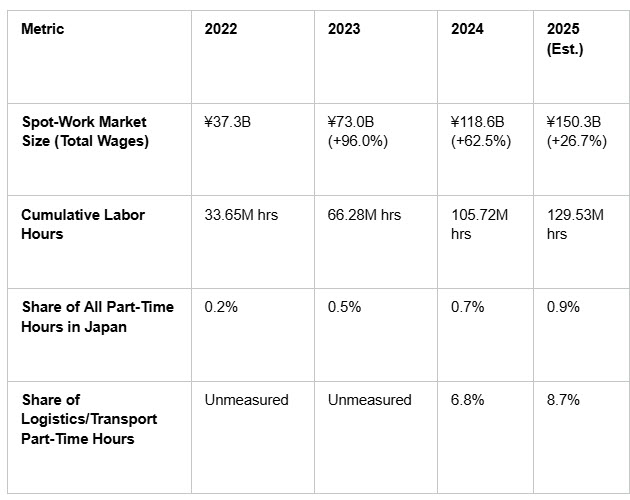
The footprint within logistics and transport assistance is particularly striking: 8.7% of all part-time labor hours in transportation and logistics are now serviced via spot-work. In an aging nation grappling with an acute contraction of its prime working-age demographic, spot-work no longer acts merely as a buffer for seasonal spikes; it functions as a critical defensive safeguard preventing supply chain and infrastructure collapse.
Operational Friction: Fast Matches vs. Frontline Fatigue
With Small and Medium-sized Enterprises (SMEs) accounting for 99.7% of all businesses in Japan, acute labor shortages pose an existential threat that directly forces reduced operating hours or business insolvency. Traditional recruitment advertising carried the risk of steep upfront fees with zero candidate guarantees. In contrast, spot-work gives employers remarkable operational agility: job postings are frequently filled within minutes, and companies only pay commission on completed shifts under a pure performance-based model.
However, beneath this efficiency lies severe friction with Japan’s celebrated frontline operations (Genba).
Historically, Japanese operational excellence relied on unspoken consensus (Aun no Kokyu), deep institutional knowledge, and collaborative bottom-up improvement (Kaizen). Yet, when operations face an influx of first-time workers on every single shift, traditional On-the-Job Training (OJT) breaks down completely.
The dividing line between operational success and collapse comes down to “Task Modularization.” Thriving businesses strictly isolate core responsibilities (such as specialized cooking and managerial decisions) for regular staff, while modularizing repetitive tasks (dishwashing, sorting, cleaning) into standalone units. These tasks are paired with intuitive checklists and two-minute video onboarding manuals. Conversely, companies that implement spot-work without operational redesign face severe burnout: regular staff spend their shifts repeatedly retraining novices from scratch and correcting errors, driving higher turnover among key personnel.
Institutional Gridlock: Labor Standards Article 38 and Verification Governance
While software has rapidly decoupled labor into micro-shifts, statutory regulations designed for early-20th-century industrial facilities are struggling to keep pace. The primary bottleneck is Article 38 of the Labor Standards Act (Aggregation of Working Hours).
Under Japanese labor law, hours worked across different employers must generally be aggregated to assess overtime thresholds. If a salaried employee works an 8-hour shift at their primary job and subsequently completes a 2-hour spot-work shift in the evening, the second employer is legally obligated to pay a 25% overtime premium on those 2 hours. In practice, verifying a worker’s external daily hours in real time across unrelated employers is nearly impossible for spot-work venues. While regulatory panels convened by the Ministry of Health, Labour and Welfare explored abolishing dual-employer hour aggregation for secondary jobs, formal legislative action was deferred, leaving businesses operating within an unresolved compliance gray zone.
Simultaneously, the nationwide rise of predatory crime recruitment (“Dark Gigs” / Yami-baito) has made platform governance an urgent public priority. In response, spot-work association members have partnered with the National Police Agency and the Ministry of Health, Labour and Welfare to deploy automated anomaly detection against deceptive, high-paying job listings, while rolling out mandatory electronic Know-Your-Customer (eKYC) screening and public personal authentication (JPKI) via Japan’s My Number Card. In a fluid, fast-moving labor market, verifiable identity tracking has become the prerequisite for operational legitimacy.
The Reshaping of Japanese Employment: Trial Shifts and Direct Sourcing
The normalization of spot-work exerts irreversible structural pressure on traditional pillars of Japanese employment: lifetime employment, rigid rotational shifts, and synchronized new-graduate hiring (Shinsotsu Ikkatsu Saiyo). Mirroring moves by IT leaders like Fujitsu to dismantle uniform new-graduate hiring in favor of job-based career tracks, spot-work embodies the ultimate expression of task-oriented labor within the hourly workforce.
Crucially, spot-work is evolving beyond standalone gigs into an on-demand platform for “Trial Hiring” (Pre-Employment).
Resumes and brief interviews often fail to reveal true work ethic or cultural alignment. By engaging candidates for a single micro-shift, employers can evaluate practical aptitude and demeanor on the actual floor before extending permanent offers. Major platforms like Timee now waive traditional placement and buyout fees when employers transition spot-workers into regular part-time or full-time roles. Furthermore, accumulated platform metrics—such as completed shifts and positive employer ratings (Good Rates)—are increasingly utilized as verified, portable credentials for career upskilling and direct corporate recruitment. The era of binding workers to fixed, inflexible schedules is waning; Japanese employment is shifting toward an era of dynamic, trial-based matching.
Conclusion: How Access Lab Bridges the Gap
As organizations increasingly depend on dynamic, external labor pools to navigate persistent labor shortages, their most critical imperative becomes “Visualizing and Standardizing Internal Workflows.”
Without granular task modularization, transparent real-time progress tracking, and robust governance frameworks, integrating on-demand labor risks introducing operational chaos and creating administrative black boxes.
At Access Lab, we support enterprises in designing and rolling out monday.com, a work platform engineered to eliminate operational silos, standardize complex workflows, and establish seamless task collaboration across distributed teams. Our Tokyo-based bilingual engineering team pairs technical systems integration with a deep understanding of Japanese enterprise culture, assisting clients from workflow architecture to long-term adoption on the frontline.
To build a resilient, scalable operational foundation that maintains precision and high productivity in an era of labor constraints, partner with Access Lab. Reach out to us today:
🌐 Official Website:accesslab.co.jp
📺 YouTube Channel:@re-skilling