
Why Global Logic Fails in the Japanese Market
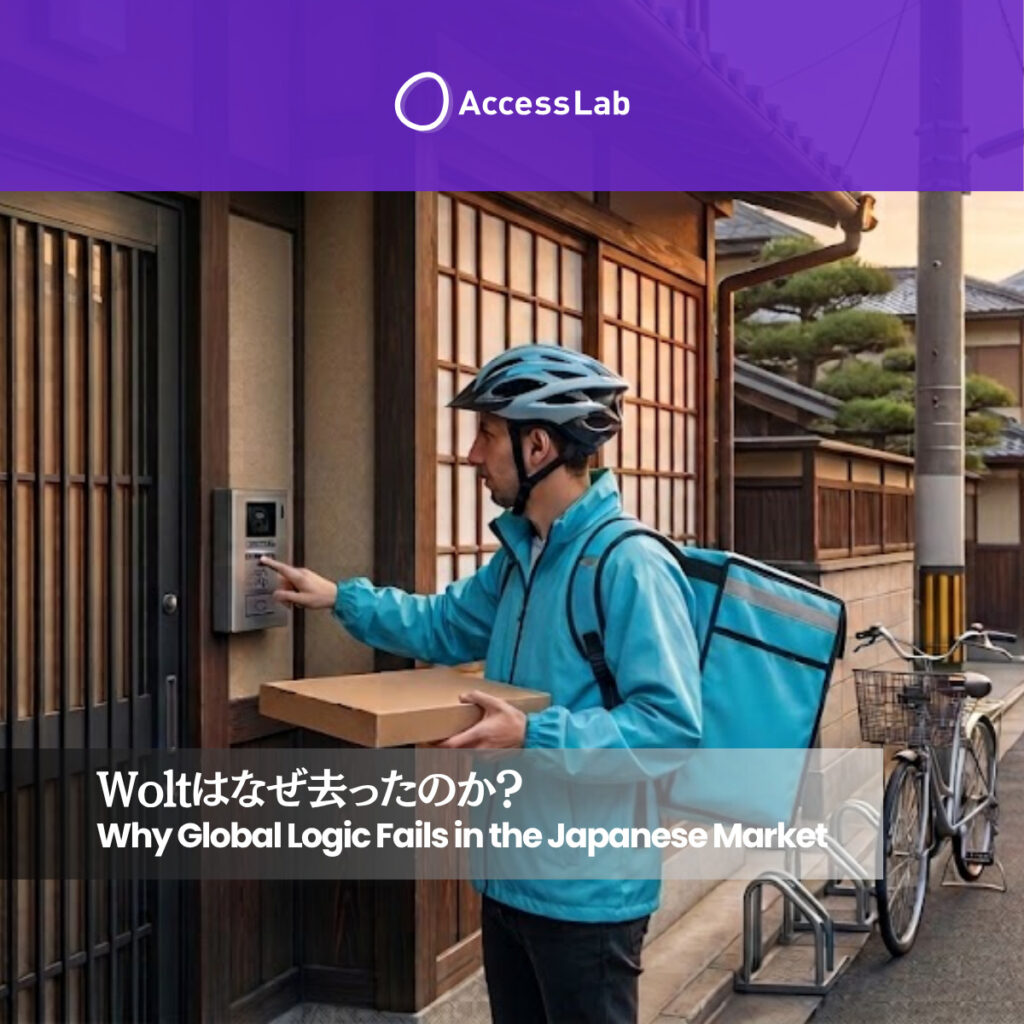
In March 2026, the fintech and logistics industries were shaken by the news that Wolt, the Finland-based food delivery service, would end its operations in Japan. Despite having a loyal fan base drawn to its high-quality service, Wolt was forced to exit. The structural dominance of the “Big Two” (Uber Eats and Demae-can), combined with parent company DoorDash’s “Selection and Concentration” strategy, made the Japanese market an insurmountable mountain.
Wolt is not alone in hitting this Great Wall of Japan. By looking at past exits of global giants, we can decode the unique difficulties of conquering this market.
Wolt & Coupang: The Wall of Logistics Costs and “Payment Culture”
In the delivery and quick-commerce sector, South Korean e-commerce giant Coupang also withdrew from its domestic Japanese operations in 2023 (subsequently shifting its strategy to “Cross-border EC” with no local inventory). The barriers for these digital services weren’t just the strength of incumbents. Japan’s complex logistics costs and the persistent cash-on-delivery culture added operational burdens that hampered global efficiency.
Tesco & Old Navy: “Hyper-Expectations” for Freshness and Quality
In retail and fashion, global models often struggle to translate.
Tesco
Despite being a UK leader, it struggled to meet Japanese consumers’ extreme demands for freshness and adapt to unique trade customs, exiting after eight years.
Old Navy
Its US-style value model failed to bridge the gap between Japanese quality standards and fierce competition from local powerhouses like UNIQLO and GU, leading to a total store closure in 2017.
Evernote: Strategic “Hub” Exit and Streamlining
Sometimes, a service remains while the local presence vanishes. Evernote, which long considered Japan one of its most vital markets, dissolved its Japanese subsidiary in 2024 following a global restructuring under new ownership. This wasn’t necessarily a failure of the market itself, but rather a case of being swept up in a global wave of cost optimization.
💡 The Truth Behind “Nemawashi”: Why is Decision-Making So Slow?
One of the biggest hurdles foreign companies face in Japan is the perceived slowness of decision-making. Bringing a “top-down, instant-decision” style often leads to dysfunction. In Japan, decisions are rarely made spontaneously in meetings. Instead, the culture of Nemawashi—building consensus behind the scenes before an official meeting—is deeply ingrained. This is a hallmark of Japan’s high-context business culture, valuing long-term relationships over raw speed. Understanding this as a process of trust-building rather than a mere delay is the first step to succeeding in Japan.
Insight: The “Context” Wall That Translation Cannot Climb
These cases share a common lesson: success in Japan requires deep Localization that encompasses culture, context, and operations—going far beyond simple Translation of language. Winning formulas that work globally can often become noise in Japan. How to bridge this gap determines who stays and who leaves.
In Closing
We hope these case studies of market exits provided helpful insights into the Japanese business landscape.
At Access Lab, we possess a deep understanding of Japan’s unique business environment and digital landscape. We provide end-to-end support, from the localization of foreign SaaS products to their implementation and long-term adoption.
We also assist with the implementation of monday.com, a platform that visualizes complex Japanese business processes and enables seamless collaboration across organizational silos.
For inquiries regarding monday.com or localization strategies for the Japanese market, please contact us below: 👇
👇 📩 Contact Us
🌐 Official Website:accesslab.co.jp
📺 YouTube Channel:@re-skilling