
Japan’s New Face of Business
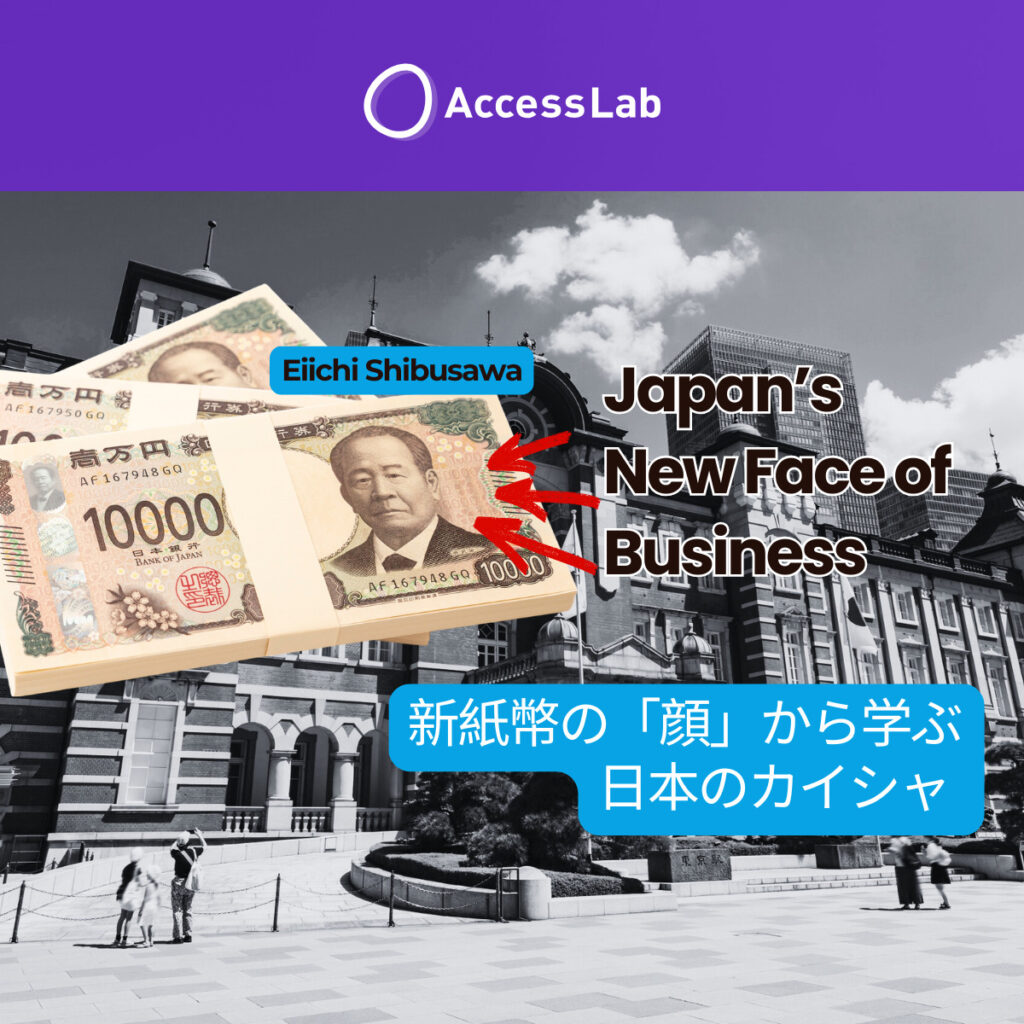
Hello everyone! Can you believe we’re already two months into 2026? Have you had a chance to see Japan’s newly redesigned banknotes?
In this article, we take a closer look at Eiichi Shibusawa—the face of the new ¥10,000 bill—and explore the company structures he helped popularize in Japan. We’ll also break down the differences between Kabushiki Kaisha (KK) and Godo Kaisha (GK), and explain how Japan legally defines “large” and “small” companies.
Eiichi Shibusawa and the Rise of the Kabushiki Kaisha
The ¥10,000 bill was redesigned in 2024, now featuring Eiichi Shibusawa, known as the “Father of Japanese Capitalism.” He was involved in founding around 500 companies and played a key role in introducing the concept of the Kabushiki Kaisha (KK)—a joint-stock company structure that remains central to Japanese business today.
Shibusawa believed that “great things can be achieved when people pool their resources.” He also emphasized that companies should serve society as a whole, not just individual gain. That’s why very few of the companies he helped establish bear his name.
KK vs. GK: What’s the Difference?
You’ve probably seen company names that begin or end with “Kabushiki Kaisha” or “Godo Kaisha.” But do you know what sets them apart?
株式会社 (KK / Kabushiki Kaisha)
The most common company structure in Japan. It’s ideal for raising capital from multiple investors and is often chosen by companies aiming to grow or go public. KKs are generally seen as highly credible and are the default for many Japanese businesses.
合同会社 (GK / Godo Kaisha)
Introduced in 2006, this is a more flexible and cost-effective structure. It allows for simpler setup and customized internal rules—making it attractive for startups and foreign companies. In fact, major global tech firms like Apple Japan, Google Japan, and Amazon Japan operate as GKs in Japan. It’s a structure that prioritizes efficiency and agility.
💡 Business Japanese Tip
The word for “company” is kaisha (かいしゃ) in Japanese. However, when it follows another word—like in Godo Kaisha—the “k” sound becomes a “g” due to a linguistic phenomenon called rendaku (連濁). Pronouncing it correctly as “Godo Gaisha” might just earn you some bonus points in your next meeting!
What Defines a “Large” or “Small” Company in Japan?
You might assume that being listed on the Tokyo Stock Exchange automatically makes a company “large,” or that low capital means “small.” But in Japan, there are legal definitions that determine company size.
Under the Companies Act: “Large Companies”
A company is considered a “large company” (daigaisha) if it meets either of the following:
- ・Capital of ¥500 million or more, or
- ・Liabilities of ¥20 billion or more
(Source: Companies Act, Article 2, Paragraph 6)
If a company doesn’t meet these criteria, it’s not classified as a large company under this law.
Under the Small and Medium-sized Enterprise (SME) Basic Act
The SME Basic Act defines “small and medium enterprises” based on industry type, capital, and number of employees:

Companies exceeding these thresholds are considered “large enterprises.”
Despite the legal distinctions, 99.7% of all companies in Japan are classified as SMEs, with only 0.3% falling into the “large enterprise” category.
(Source: Organization for Small & Medium Enterprises and Regional Innovation)
In Closing
We hope this edition gave you a helpful overview of Japan’s company structures and how they’re defined.
Understanding the “shape” and “scale” of Japanese companies can offer valuable insights when building business relationships.
💼 Need Support with monday.com??
At Access Lab, we support companies of all sizes in implementing monday.com, a powerful platform for managing workflows and collaboration.
📩 For inquiries about monday.com, feel free to reach out here: https://wkf.ms/3C0OMqH